This article is mainly written for the existing life insurance agents who have outgrown the agency environment; those who are considering a career in life insurance and financial planning; and life insurance purchasing public who want to know the changes happening in the industry that will benefit them.
Way back in 2008, I wrote in my life insurance blog, “Realising that my practice must do more than just product peddling and single-need focus, especially after I qualified for my ChFC, CLU, CFP in early 2003, I stumbled on this classic book written by the life insurance industry legend, Norman Levine, ‘From Life Insurance to Diversification’.”
This wonderful book was published in US in1987 (yes, it was 24 years ago) and Norman Levine wrote to share his experience about how he re-engineerd his practice/business model in response to the changes in the life industry in the US at that time.
Mind you, the changes experienced by Levine in the US in the 1980’s were exactly the same as what we are experiencing now in Malaysia in the past few years.
In his book, he remarked that until the mid-1970’s, life insurance selling was a relatively traditional and well-established business. It was almost exclusively dependent upon life insurance agents to market what were basically very traditional and sometimes antiquated products.
However, everything that had been traditional and constant suddenly experienced a dramatic evolution which some perceived to be a shocking revolution – banking, stock brokerage houses and most particularly the life insurance industry struggled through innovation and experimentation to cope with this noticeably evolving environment.
Levine said in his book, “Like everyone else, I found myself questioning every aspect of my business. Products that I had relied on were questioned or challenged by potential clients and my own self-confidence began to erode. Since all the books I have ever read and all my sales presentations and procedures I had ever used were based on the challenged yesterdays, I could find no proven track to run on.”
“I, like most other practitioners, continued to make do with procedures that still had some limited effectiveness, but at the same time I began to experiment and invent new wheels. Finally there was a little light at the end of what had been a frightfully long tunnel.”
Levine continued in the book, “Now just a few years later, my personal sales operation and the organisation that I built to support that operation, only vaguely resembles the traditional organisation that had worked so effectively for the first 30 years of my insurance career.
For the first time in many years my business and the future are very exciting. I am dealing with a more select group of prospects and clients. These people are more stimulating, challenging and more rewarding in every way.”
Ready-made versus custom-made analogy
There was one concept in Levine’s book that struck me. Levine said, “Let me begin with an analogy – if you are going to buy some new clothes, you could go to a store that sells ready-made clothes or to a custom tailor. Usually price is the main basis for your decision.”
For most people, it was simpler and cheaper to buy ready-made but have to live with the compromises because you could not get the exact fabric, or print or colour you really wanted.
Even if all of those were perfect, you had to find the right style. Or you might prefer to go to your favourite tailor, pick out the exact fabric, pattern and colour, and then get fitted very precisely as the finished garment was perfect for you.
In the modern total financial services world all solutions, even at the most basic level, require a customised approach.
Due to the unique needs and financial situations of our prospects, and with the great varieties of products and services now available, each practitioner must make some basic decisions about which type of prospect they wish to serve and what products and services were necessary to do the job right.
• the market;
• the products; and
• the salesperson’s current level of expertise.
Pursuing the ready made versus custom made analogy, there have been changes in consumers’ attitude – increasing demand for ‘high touch’ in the sales process – they want someone to care enough about them as individuals, to feel their financial concerns, and to respond with sensitive financial solutions.
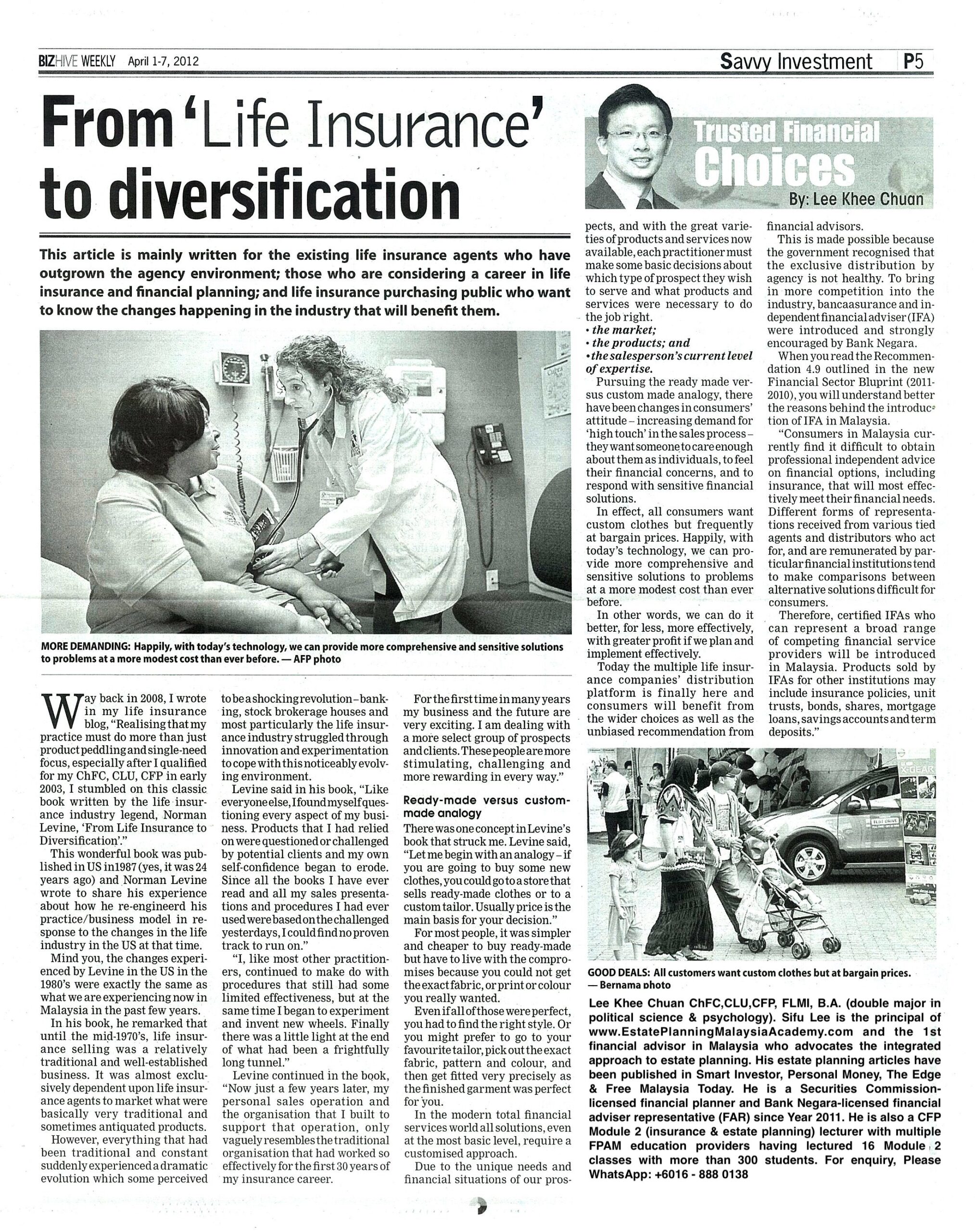
In effect, all consumers want custom clothes but frequently at bargain prices. Happily, with today’s technology, we can provide more comprehensive and sensitive solutions to problems at a more modest cost than ever before.
In other words, we can do it better, for less, more effectively, with greater profit if we plan and implement effectively.
Today the multiple life insurance companies’ distribution platform is finally here and consumers will benefit from the wider choices as well as the unbiased recommendation from financial advisors.
This is made possible because the government recognised that the exclusive distribution by agency is not healthy. To bring in more competition into the industry, bancaasurance and independent financial adviser (IFA) were introduced and strongly encouraged by Bank Negara.
When you read the Recommendation 4.9 outlined in the new Financial Sector Bluprint (2011-2010), you will understand better the reasons behind the introduction of IFA in Malaysia.
“Consumers in Malaysia currently find it difficult to obtain professional independent advice on financial options, including insurance, that will most effectively meet their financial needs. Different forms of representations received from various tied agents and distributors who act for, and are remunerated by particular financial institutions tend to make comparisons between alternative solutions difficult for consumers.
Therefore, certified IFAs who can represent a broad range of competing financial service providers will be introduced in Malaysia. Products sold by IFAs for other institutions may include insurance policies, unit trusts, bonds, shares, mortgage loans, savings accounts and term deposits.”